
Sometimes emergencies don’t arrive with sirens.
Sometimes they begin quietly — with a nudge that says something isn’t right.
It started quietly.
That’s the strange thing about emergencies — sometimes they don’t announce themselves with panic or flashing lights. Sometimes they begin with discomfort that doesn’t quite make sense, followed by that internal whisper that says pay attention.
By the time we arrived at the ER, we already knew this wasn’t going to be simple.
Scott had a kidney stone blocking his ureter. The blockage had caused his kidney to begin failing, and infection had set in. The local ER did what they could, but it quickly became clear they could not handle what was needed.
The solution?
Transport by ambulance — over three hours away — to Burlington, Vermont.
Just like that, the day split in two.
Scott would go ahead in the ambulance.
(I asked if he could have a window seat.)
I would follow later.
In the dark.
On rural winter roads.
With snow still lining the pavement, no visible lane markings, and that familiar northern wind that blows powdered ice across the blacktop just enough to make you question every mile.
At least it wasn’t actively snowing, I told myself.
That felt like optimism.
The ER That Locked Its Doors
When I arrived in Burlington, the ER felt like another world.
I’d been in big-city emergency rooms before — sprawling and busy — but this was different.
This ER was in lockdown.
I walked in and was immediately met with what looked suspiciously like airport security.
A guard handed me a small gray bin. I assumed I’d be emptying my purse into it — wallet, keys, snacks, the usual chaos.
Instead, he said calmly:
“You can only bring your phone and ID.”
Not my snacks.
Not my bag of “just-in-case” supplies.
Not the things I’d brought for Scott knowing I’d likely be there for hours.
And definitely not Bert.
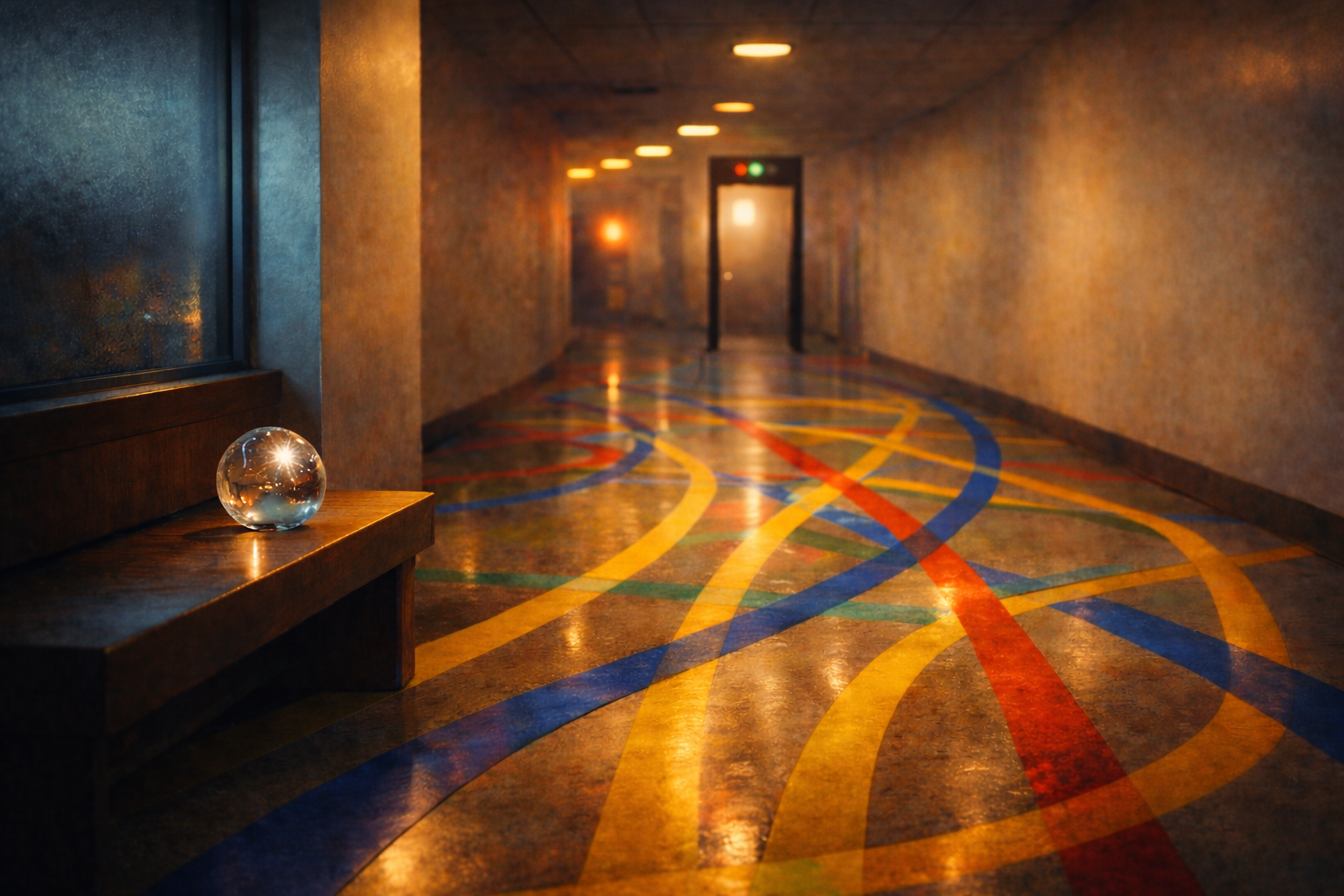
Bert, my crystal ball — my support crystal, my emotional anchor, my silent little ally when life gets overwhelming.
I had a brief fear they’d see him and accuse me of trying to smuggle in a weapon.
Instead, they confiscated my entire purse.
With Bert inside it.
I remember thinking, Well… I may never see either of them again.
In my off-balance state, I also left my car keys in that purse.
When I realized it a moment later, I refused to think about it.
I simply could not.
The guard pointed toward the metal detector.
“Are you wearing anything that will set this off?”
My mind went completely blank.
I stared at him with what I can only assume was a full deer-in-the-headlights expression.
I couldn’t remember what I was wearing.
Not because I’m forgetful — but because stress does that. It disconnects you from your body in the strangest ways. I stood there honestly unsure whether my own clothing or accessories posed a threat.
“I don’t think so,” I said.
“Well,” he replied, “there’s only one way to find out.”
Thankfully, I passed without lights or sirens.
Follow the Lines
I was directed toward a glass-fronted cubicle with four men inside.
Through a tiny hole cut into the glass, I tried to explain that I had just driven over three hours in the dark to get there before my husband’s emergency surgery.
One man said, “Someone will help you,” stood up, and walked away.
The other three stared at me.
Not rudely.
More like they were silently drawing straws to determine who would have to interact with the distressed woman standing in front of them.
One stepped forward.
Apparently, he lost.
The other two immediately left.
He waited a few extra seconds — perhaps hoping I’d disappear — before finally speaking.
Then he pointed to a map taped flat to the desk.
A map bigger than any hotel evacuation diagram I’d ever seen.
It was upside down.
Completely.
From my side of the desk, everything was inverted.
He traced the route with his finger — red line to green line to blue — explaining it slowly and confidently, as if my brain were currently capable of rotating images in three dimensions and storing them for later recall.
At this point:
- my purse had been confiscated
- my husband was heading into emergency surgery
- I had just been questioned about my own clothing
- and I was being given directions upside down
I nodded.
Because that’s what we do when we don’t understand something but feel it’s far too late to ask for clarification.
Now I had to play follow the hospital art — like a preschool activity gone wrong.
The Maze
As I wandered the halls trying to determine which green line was the green line, I spotted a security guard.
He was looking everywhere but at me.
That universal posture of: If I can’t see her, she can’t see me.
“Excuse me,” I said softly. “I’m sorry to bother you. Which way do I go to Blue W?”
He sighed internally — I’m certain of it — and pointed down the hall.
“Turn left at that chair.”
I walked to the chair.
Solid walls on both sides.
No hallway.
No turn.
Just… wall.
Every employee who passed looked anywhere except directly at me.
Eventually I chased one down — literally — like I was pursuing my loose dog.
They gestured vaguely down another corridor.
I headed that direction.
And then I heard Scott’s voice.
I had found him just in time.
He was already being prepped for surgery.
A kind ER nurse noticed my distress as I tried to understand how I was supposed to follow the colored lines in reverse order to retrieve my purse — and then somehow find my way back again.
She took my claim check and retrieved my purse herself.
Bert was returned.
The surgery team may have been tapping their toes by the time Scott reached the OR, but once they heard the story, they just shook their heads and chuckled. “That’s our security.”
But my sanity was preserved.
The Waiting Room After Hours
The surgical waiting room lights had been dimmed — likely under the assumption no one would be there.
But there were two of us.
Me — and another person waiting quietly for their loved one.
Two islands in the dark.
I sat down and pulled out snacks, trying to eat and process everything that had already happened — and everything still ahead.
My mind spiraled.
Should I walk back to the ER?
Go to the parking garage?
Drive around the building?
Carry Scott’s belongings back — miles and miles again — then make it to the hotel?
What did being a good, loving wife mean in this moment?
My body was barely hanging on after the walk from the ER to surgery.
Guilt wrestled with self-preservation.
Then came the second-guessing.
Why did I even come tonight?
Tomorrow would have been easier.
But I knew the answer.
I came because the only thing Scott could control on this crazy carnival ride was knowing I was nearby — close enough to make decisions if the roller coaster jumped the rails.
It’s amazing what the mind does when it’s overtired and overloaded.
Eventually, I accepted I could not do any more walking.
When the surgeon called and said everything went well — Scott would be able to go home the next day — I finally let out a breath I didn’t realize I’d been holding.
I went back to see him briefly.
We said our goodbyes.
I left the hospital an hour before my chariot was scheduled to turn back into a pumpkin.
The Hotel Maze
The town prides itself on being green — in both senses of the word.
Built among trees.
Muted lighting.
Recycle. Reduce. Reuse.
Add snow, unfamiliar roads, and an overtired brain, it’s a wonder I made it there at all.
But I did.
My room number was 428.
“To confirm,” I asked, “that’s on the fourth floor?”
“No,” the clerk replied confidently. “Second floor.”
I stared at her.
Room 428… on the second floor.
She showed me a map — yes, another very large map — with a 428 nestled comfortably among the 200s.
I was too tired to argue with numbers.
I hauled my bags down a long hallway, turned a corner, walked another long hallway…
No 428.
I found 228.
Tried the key.
Nope.
Back to the desk.
She insisted I must be mistaken.
Security was offered.
“Yes, please.”
Security arrived and immediately pressed the button for the fourth floor.
“What?” I asked.
Turns out the clerk was new.
We walked miles — again — to room 428.
I opened the door.
It was a suite.
Living room.
Kitchen.
Bedroom.
Beautiful.
Completely unnecessary.
All I wanted was one small bed in one small room.
I stood there in disbelief, walking in circles, wondering if exhaustion had finally tipped me into an alternate reality.
No — tonight was not the night for an upgrade.
I calmly — well, mostly calmly — called the front desk and explained that I hadn’t requested this room and would very much like to know how much it cost.
Then I walked miles back again.
Room 208.
Key didn’t work.
Back again.
Room 126.
She escorted me herself.
No help with the bags.
The sweat pouring down my face drew no comment.
The key didn’t work.
She used her master key.
“You’ll need to make sure my key works,” I said gently but firmly.
“I’d like to be able to get back into my room.”
Sleep came in fragments.
The Final Crossing
At 7:30 a.m., Scott received the good news — he would be discharged.
I waited until checkout, hoping I could simply pull up front and have him hop in.
Nope.
Paperwork delays.
Equipment glitches.
Eventually valet parking saved my legs — only a mile this time, not miles.
At 3:30 p.m., a nurse came running into the room, waving the discharge papers like a long-awaited pardon.
She knew.
One signature later, we were free.
The drive was beautiful until we crossed the invisible line:
Now Entering New York.
At the start of the long bridge over Lake Champlain, the energy shifted.
Everyone who makes that drive feels it.
The snow fell heavier.
For an hour and a half, we fought squalls — drive, stop, wait, drive again as visibility vanished.
We finally made it home after 7:00 p.m.
Unloaded the truck.
Went straight to bed.
The cat and the teenager could fend for themselves.
We were home.


Your turn to stir the tea